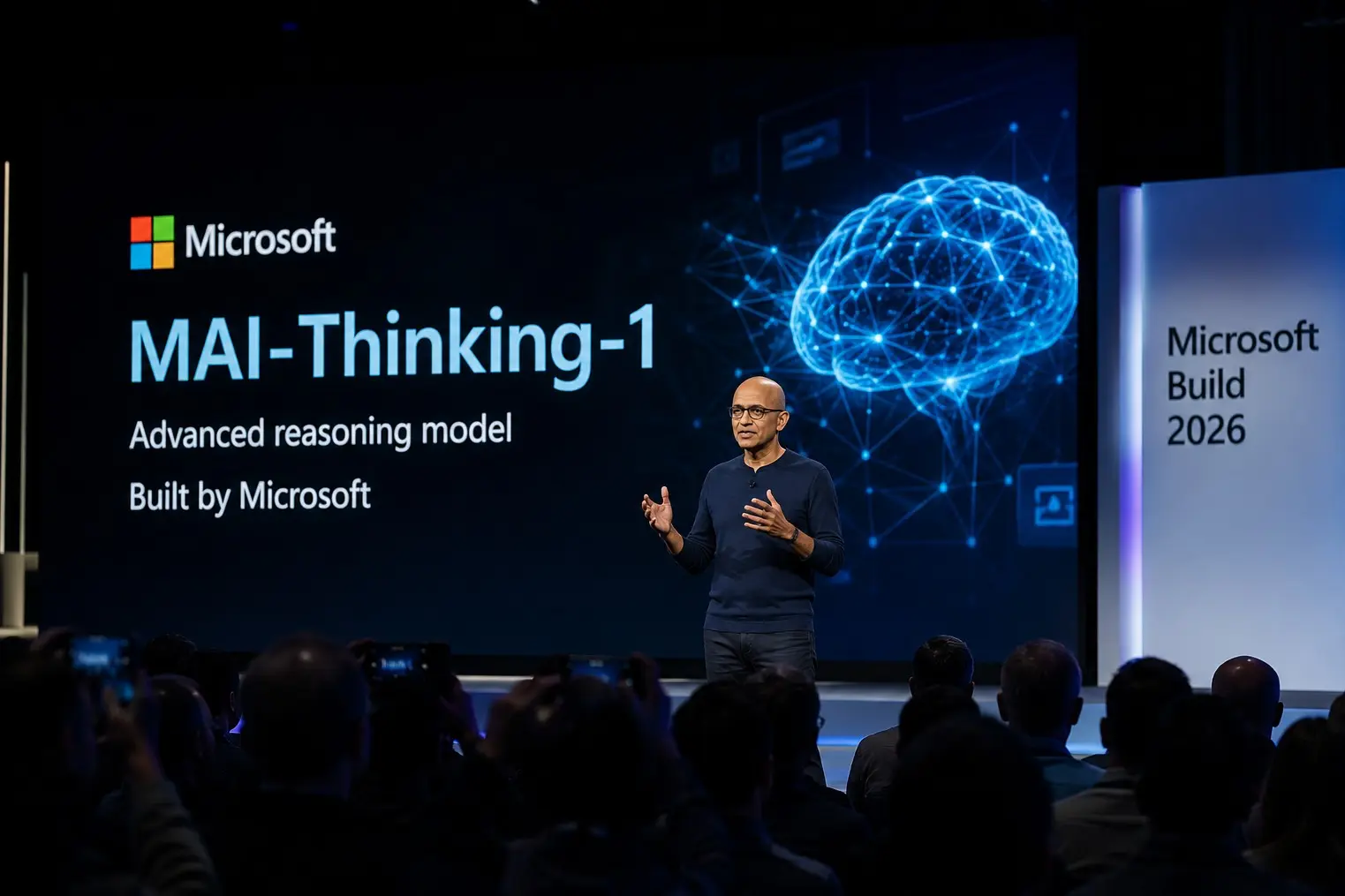
Microsoft Unveils MAI-Thinking-1: Advanced Reasoning AI Signals New Independence From OpenAI

June 3, 2026
Alex - aiToggler Team
Reviewed by a two-legged human.
Microsoft's annual Build developer conference is always where the company rolls out its biggest bets, but this year landed differently. If you follow AI, you probably saw the headlines: Microsoft announced its first in-house advanced reasoning AI model, MAI-Thinking-1. New models launch every week, but this one is worth watching. Microsoft appears to be signaling that it wants to compete more directly with players like OpenAI and Anthropic, not just fund them.
Microsoft steps out of OpenAI's shadow
For years, Microsoft has been known as OpenAI's most important partner. Azure powers ChatGPT, and Microsoft has invested billions into that relationship. But at Build 2026, the company took a visible step toward reducing that dependency.
According to The Verge's event roundup, Microsoft announced seven new in-house AI models, including MAI-Thinking-1. Microsoft describes MAI-Thinking-1 as its first model built specifically for "complex multi-step instructions, long-context reasoning and code generation."
That alone would get attention, but the specs help explain why people are taking it seriously. MAI-Thinking-1 reportedly has 35 billion active parameters and a 128K context window, which puts it in the same general class as leading models like GPT-4 for many tasks, at least on paper.
The training story is what caught my eye, though. Microsoft says the model was trained "from the ground up on clean data, without distillation from third-party models" (The Verge). That sounds like a pointed comment on the broader trend of training newer models on outputs from older ones. Microsoft appears to be trying to position this as more original work and, by extension, as a step toward more independence in its AI stack. That is a technical claim, but also a negotiating position.
What is special about MAI-Thinking-1?
Every big tech launch promises a leap forward, so it is fair to ask what is actually different here.
Microsoft says MAI-Thinking-1 is designed for "reasoning" tasks. In practice, that means things like handling multi-step logic, working across long documents, and tackling software engineering problems rather than just autocomplete-style text generation.
The model is described as "medium-sized" relative to the very largest frontier models, but Microsoft is claiming state-of-the-art performance on software engineering benchmarks. That emphasis makes sense, given that Build is a developer conference and Microsoft's whole pitch is about making Windows, GitHub, Azure, and Office feel more AI-native.
What gets me is how tightly this fits into the rest of the announcements. This is not a one-off model reveal. Build also brought updates to Microsoft's image, voice, and code generation models, plus work on bringing AI agents like OpenClaw into Windows with built-in safety guardrails. On top of that, Microsoft teased hardware aimed at local AI development, hinting at a full-stack story from silicon to cloud to apps (The Verge).
All of this paints a picture of MAI-Thinking-1 as one piece of a bigger developer-focused toolkit rather than a standalone "chatbot." Whether it lives up to the reasoning branding will come down to how it performs in real-world use, not just on stage demos.
Why this matters for the AI industry
The timing here is hard to ignore. Microsoft and OpenAI recently renegotiated their partnership to "loosen ties," according to The Verge. At the same time, there are reports of Anthropic exploring an IPO and Google is pushing its own AI stack everywhere it can.
In that context, Microsoft's push for in-house models looks less like a cool side project and more like risk management. If Microsoft controls its own models, it has more say over pricing, features, deployment, and long-term roadmaps. It also avoids being in the awkward position of relying on a third party for something that is now core to Windows, Office, GitHub, and Azure.
The side effect is more fragmentation. We already had Google, Amazon, and Anthropic building distinct model families and platforms. Adding a more independent Microsoft stack on top of OpenAI and others means there is even less chance of one or two models dominating everything.
For developers and enterprises, that cuts both ways. More choice means more room to pick models based on cost, performance, and policy. It also means more integration work, more platform differences to learn, and more uncertainty about which stack will age well.
I keep coming back to this: the AI "platform wars" are starting to look a lot like the old OS and cloud fights, just compressed into a much shorter timeline.
The road ahead: more than just models
So, is MAI-Thinking-1 a "GPT-4 killer"? There is not enough public evidence yet to make that call, and the marketing language around "reasoning" is doing a lot of work. Benchmarks and real user testing will matter more than launch-day claims.
The more interesting story is that Microsoft is clearly trying to move from being seen mainly as OpenAI's infrastructure partner to being seen as an AI builder in its own right. Between MAI-Thinking-1, the broader model family, the Windows integration work, and the hardware hints, Microsoft is putting pieces in place to compete across the stack instead of only through investment deals.
If you work in tech, this is the kind of shift that changes roadmaps. Which SDKs you support, which models you fine-tune on, what you optimize for in your own products, all of that gets a little more complicated when a partner like Microsoft starts to look more like a direct AI vendor.
Whether this leads to a more open, interoperable AI ecosystem or just more silos with better marketing is very much an open question. For now, MAI-Thinking-1 looks like the starting pistol for a more independent Microsoft in AI, not the finish line.
If you want to keep up with Microsoft's next moves and how they ripple through the rest of the industry, stick around. This story is just getting started.